


Communication strategies to help children transition back to school after the holidays
Discover how social stories help children navigate new experiences with confidence. This guide explains what they are, how they work, and how to create your own step by step.
Payel Chakraborty
2/28/20264 min read
The start of a new school term can feel overwhelming for any child, especially after a long break for holidays. Transitions for neurodivergent kids often brings more challenges – changes in their routine, more structured communication demands and social expectations, new teachers, new classrooms, the list goes on! There are communication strategies you can use before the school term starts that can make a difference in helping your child feel calmer and more ready for this transition.
In this article, we’ll cover:
Why communication makes a difference in supporting school transitions
Parent-friendly strategies you can use
Visual tools to help support language and create predictability
How to effectively communicate with your child and their school
Why does communication support school transitions?
After school holidays, a child’s daily routine changes in a large way. This may bring experiences of confusion, worry, anxiety or reduce their participation in activities at school.
Communication that is clear and predictable can help reduce uncertainty and also provides the child with the language and extra bit of confidence to express their needs and feelings.
Consistent conversations and visual tools provide them with the foundations for a smoother transition back to school.
1. Start with open conversations
Talk early and often about returning to school. Use calm moments to discuss:
What your child likes about school (friends, favourite activities)
What they dislike about school, what are their worries/concerns
A step-by-step of what their first days will look like
Validating how they feel — “It’s okay to feel nervous about that” — helps your child know their voice, thoughts and feelings matter.
Conclusion
Going back to school after the holidays is a big change. For neurodivergent children, thoughtful and supportive communication can make a positive difference to the transition. Preparing early, implementing visual tools, practising self-advocacy and working with your child’s school team can create a sense of predictability, safety and calm that helps your child feel supported and understood.
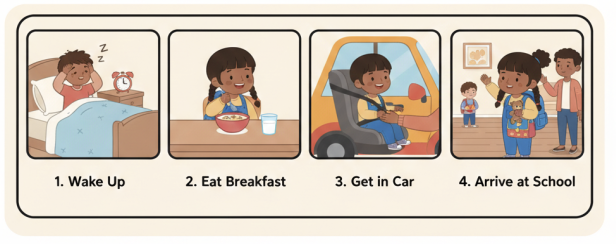
2. Use visual schedules to clarify how their day will look
Visual schedules are great tools to support neurodivergent learners. They can be made using simple pictures, drawings, or words showing things like ‘morning routine’, ‘school activities’, ‘after school activities’. Try using realistic photos like pictures of their teachers or a picture of the front of their school or their classroom to increase the predictability of their day. Visual schedules help children see what’s expected rather than just hear it, which is helpful for memory and processing.
Visual examples you can include:
✔️ First–Then Charts – “First school, then favourite game.”
✔️ Daily Routine Strips – Pictures of waking up, eating, getting in the car, and school activities.
✔️ Social Story Pictures– A short illustrated story about “What to expect on the first day back.”
3. Practice important self-advocacy phrases
The transition back to school may be overwhelming, so it’s important to remind your child of the things they can say or do to get support during these moments. Try practising short, supportive rehearsals of phrases like the following:
“I need a break”
“Can you say please say that again?”
“I need help, please.”
Role-playing helps children generalise communication skills before they’re expected to use them in real settings, which builds their confidence, and reduces the stress and cognitive load of working out what to say.
Some children may find it hard to ask for a break or say when things are too much, or they may use different methods of communication, so simple break cards (e.g., ‘I need a break’) can empower your child to communicate needs without relying on spoken language.


4. Communicate with the school
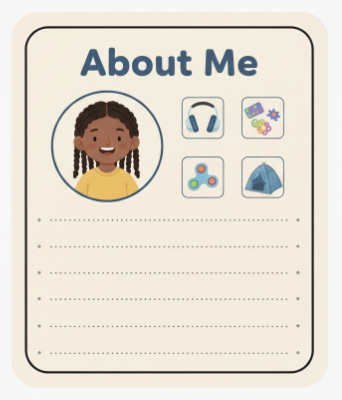
Parents know their child best. They know their child’s strengths, sensitivities, areas they needs support in and the communication supports that are most effective at home. It’s important to pass this information on to their teachers and aides. A quick one-page information sheet, such as an ‘About Me’ document, or a communication book can help generalise strategies used at home and at school so your child experiences consistency across the different environments.
Need support? Get in touch!
Have questions? Feel free to reach out or drop them in our question block below—we’d love to help!
If you think your child would benefit from working with an speech therapist, feel free to fill out our referral form, and we’ll be in touch to support you on this journey.
Join the conversation
If this article has inspired you or raised questions, we’d love to hear from you. Share it with others who might also benefit from these ideas and help us spread the message further.
Together, we can celebrate differences and build a society that embraces neurodiversity in all its forms.
This content has been created for informational purposes only and should not replace professional evaluation. The article has been reviewed by our editorial team.
References
Marsh, A., Spagnol, V., Grove, R., & Eapen, V. (2017). Transition to school for children with autism spectrum disorder: A systematic review. World Journal of Psychiatry, 7(3), 184–196.
Do you have a comment?

Find us here
258 Warrigal Road, Glen Iris, VIC 3146
Follow us

ABN 93673889506
Member of UniHub Monash University

Call us

We acknowledge the Traditional Aboriginal Owners of Country and pay our respects to them, their connections to land, sea, and community. We pay our respects to their Elders past and present and future Traditional Owners.
We respect and welcome people of all backgrounds, genders, sexualities, abilities and cultures.

